

 Facebook
 X
X
 Pinterest
 Copy Link
Artificial intelligence is becoming remarkably good at helping with real estate. It can search thousands of listings in seconds. It can organize information, summarize documents, analyze market data, identify trends, draft communications and help buyers and sellers navigate an increasingly complicated process. All of that is useful.
After 45 years practicing law and working as a mediator in Southeastern Pennsylvania, I came to real estate with a different perspective on the importance of listening, negotiation, judgment and—above all—trust.For me, real estate isn’t just about houses. It’s about helping people make good decisions about where and how they want to live. That’s something no algorithm can do for you.
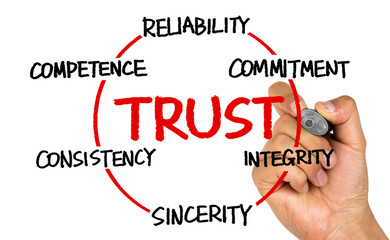
A real estate transaction is not simply a process of moving information from one computer to another. It is a transaction between people. And when the stakes are high—as they usually are when you’re buying or selling a home—people need something more than data. They need to trust the person sitting across the table.
Real estate is a relationship business
Consider what happens when a buyer tells an agent:
“I really like this house, but something doesn’t feel right.”
An algorithm can identify comparable properties. It can calculate the financial implications of an offer. It can generate a list of questions to ask. But the important question may not be any of those things.
What is making the buyer uncomfortable?
Maybe the buyer is worried about spending too much. Maybe the house reminds them of a previous home the buyer regretted buying. Maybe the location is farther from family than they originally realized. Maybe they are simply afraid of making a major decision.
Those are human concerns.
They don’t necessarily appear in a spreadsheet, a listing description or a market report.
As in the context of mediation (with which I have more than a passing familiarity) an experienced real estate professional learns to listen for what is being said—and sometimes for what isn’t being said.
Trust matters even more when the market and/or the transaction gets complicated
The need for trust becomes particularly important when a transaction doesn’t proceed exactly as planned. Perhaps the inspection reveals an unexpected problem. Perhaps the appraisal comes in below the contract price. Perhaps the title report reveals an unexpected lien or encumbrance. Perhaps the seller receives another offer. Perhaps the buyer becomes concerned about the condition of the property. Perhaps a closing date suddenly becomes difficult for one of the parties.
At those moments, the value of a real estate professional isn’t simply knowing the next procedural step.
It is knowing how to evaluate and communicate it.
Should you push? Should you wait? Should you negotiate? Should you recommend that your client walk away? Should you bring the parties together—or give them some space?
Those decisions require more than data. They require judgment, communication and an understanding of the people involved.
Negotiation isn’t just about price
This is an area where my previous career as a lawyer and mediator has profoundly influenced the way I approach real estate. Good negotiation isn’t about winning every point. It’s about understanding what actually matters to each side.
Sometimes the difference between a successful transaction and a failed one isn’t the purchase price. It might be the settlement date. It might be personal property. It might be a repair. It might be possession after closing. It might be the certainty that the transaction will actually close.
Two parties can look at the same facts and reach completely different conclusions about what is important. That’s where human negotiation still matters.
An algorithm can tell you that two positions are $10,000 apart. A human being can sometimes discover why that $10,000 matters so much to one party—and perhaps why it doesn’t matter nearly as much to the other.
That distinction can change the outcome.
Relationships are especially important in real estate transaction on Maryland’s Eastern Shore
For buyers coming to Maryland’s Eastern Shore from Pennsylvania, New Jersey, Northern Virginia or elsewhere, the relationship can be even more important. You’re not just buying a house. You’re often learning a new community.
You’re figuring out where you’ll shop, where you’ll keep your boat, where you’ll play golf, where you’ll find a doctor, where your grandchildren will visit, where you’ll have dinner, where you’ll spend your weekends and whether this really is the place where you want the next chapter of your life to unfold!
Online information can tell you a great deal about a community. But it can’t tell you what it feels like to be there. It can’t replace the local perspective of someone who knows the roads, the neighborhoods, the waterfront, the towns and the people.
And it certainly can’t replace someone who will answer your phone call when you’re trying to make an important decision.
AI isn’t the enemy
None of this means that artificial intelligence has no place in real estate. Quite the opposite.
I expect AI to become an increasingly valuable tool for both consumers and real estate professionals. It can make information more accessible. It can save time. It can help us identify questions we might otherwise overlook. It can make complicated information easier to understand.
And it can allow a good real estate professional to spend less time on routine tasks and more time with clients.
That’s a good thing.
The mistake would be assuming that because AI can automate parts of a transaction, it can replace the relationship that makes the transaction work. It can’t.
The most important technology may still be a conversation.
Buying a home is ultimately an intensely personal decision. You’re choosing where to live. You’re committing a substantial amount of money. You’re making decisions that can affect your family for years.
And sometimes you’re making those decisions during one of life’s major transitions—retirement, relocation, marriage, divorce, inheritance or the loss of a spouse.
In those circumstances, people don’t simply need answers. They need someone who will listen.
Someone who will tell them when they’re making sense—and when they may be overlooking something. Someone who isn’t afraid to say, “I’m not sure this is the right house for you.” And, perhaps most importantly, someone whose advice they trust.
Beyond the algorithm
The future of real estate won’t be AI versus humans.
It will be AI helping humans do their jobs better.
The best real estate professionals will use technology to become more efficient, better informed and more responsive. But they will still do something technology cannot do:
They will build relationships.
Because a house can be found by an algorithm. Market data can be analyzed by an algorithm. Documents can be summarized by an algorithm.
But trust?
Trust must be earned.
And that remains very much a human endeavor.
______________
Eastern Shore Insights™
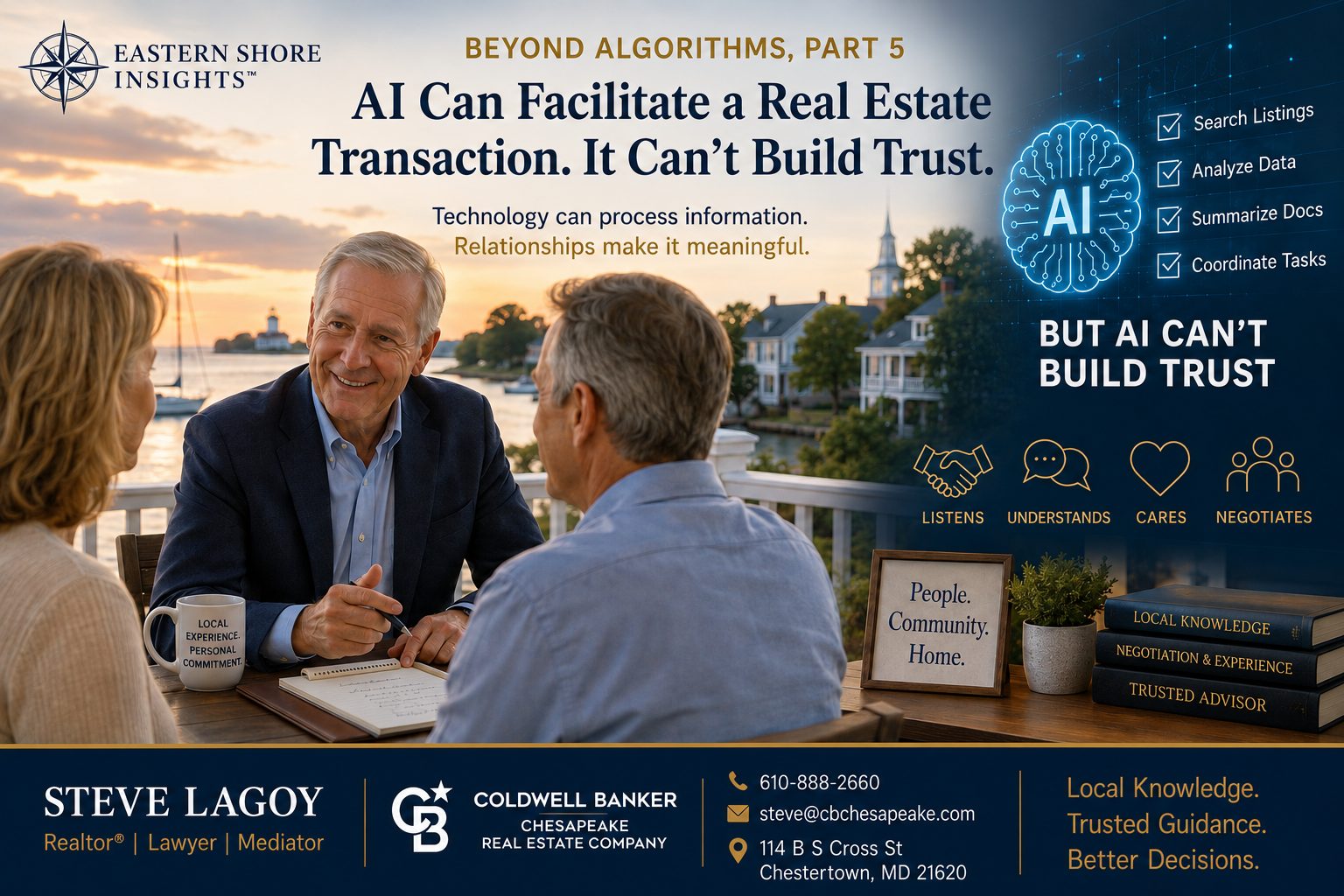
Eastern Shore Insights,™ Beyond Algorithms is an ongoing series exploring what technology can—and cannot—do when it comes to real estate, homeownership and choosing a life on Maryland’s Eastern Shore.
Steve Lagoy, Associate Broker
Coldwell Banker Chesapeake
114 S Cross St Ste B, Chestertown. MD 21620
steve@cbchesapeake.com
www.isellmdes
MD 5014893
(410) 778-0330 (office), (610) 888-2660 (mobile)
